PaintlessDentRepairvsTraditionalPanelRepair—What'stheDifference?
Proudly partnered with McKenzie's QLD
When your vehicle picks up a dent, the first question most people ask is how much it's going to cost. The honest answer is: it depends on the type of damage, and specifically on whether the repair can be carried out using paintless dent repair (PDR) or whether it needs a traditional panel repair. The two methods are fundamentally different, and choosing the right one matters — not just for cost, but for how the repair holds up and how it affects the long-term condition of your vehicle.
What Is Paintless Dent Repair?
Paintless dent repair is a technique that removes dents from vehicle panels without touching the paint surface. A technician uses a set of specialised metal rods and picks to access the back of the damaged panel — usually through gaps in door frames, behind trim panels or via existing openings in the body — and carefully massages the metal back into its original shape.
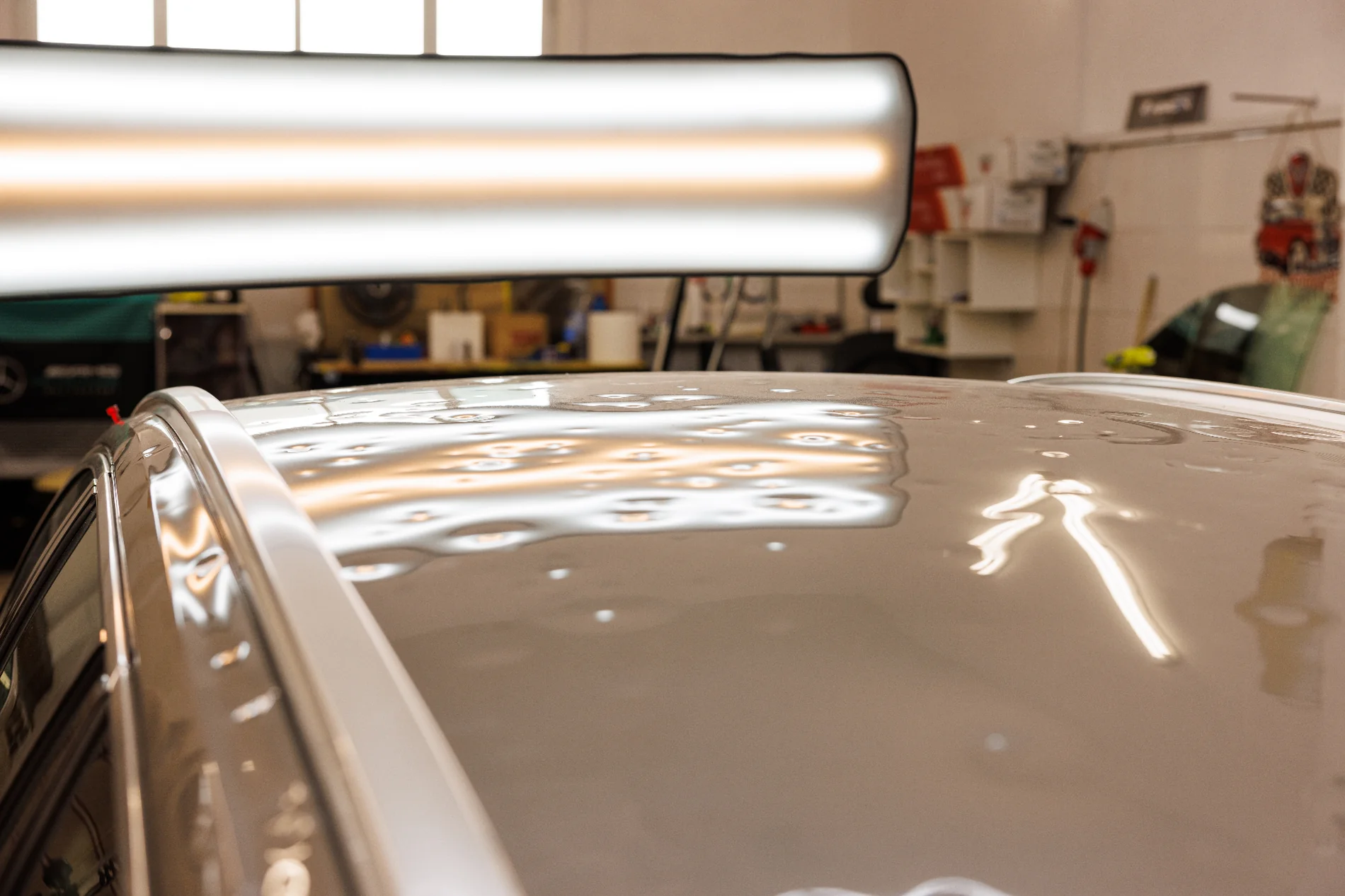
The process requires patience and a trained eye. The technician works gradually, applying controlled pressure from behind the panel while viewing the dent under a reflection board or light bar that shows the shape of the surface clearly. Carried out properly, the result is a panel that looks factory-straight, with no filler, no paint and no sign the dent was ever there.
PDR is used on everything from door dings and parking knocks to hail damage. In the case of widespread hail damage — where a vehicle might have dozens of small dents across the bonnet, roof and boot — PDR is usually the only practical and cost-effective solution, as repainting every panel would be prohibitively expensive.
What Is Traditional Panel Repair?
Traditional panel repair covers situations where the damage is too severe or the paint is too compromised for PDR to work. The process typically involves straightening the panel using a panel hammer and dolly, applying body filler to even out any surface imperfections, sanding the area back, priming it and then repainting the panel to match the rest of the vehicle.
In more serious cases — particularly after a collision — the repair might involve replacing the panel entirely rather than trying to straighten it. Some panels, particularly structural components, are better replaced than repaired to maintain the vehicle's safety and rigidity. After any major structural work, a wheel alignment and possibly a chassis measurement check may also be required.
Paint matching is one of the most technically demanding parts of a traditional repair. Modern computerised colour-matching systems read the vehicle's paint code and use it to mix a precise formula, but on older vehicles the existing paint may have faded or shifted in colour over years of sun exposure. An experienced panel beater adjusts for this by blending the new paint into surrounding panels so the transition is seamless rather than obvious.
When PDR Works — and When It Doesn't
PDR is suitable when:
- The dent is shallow, with no sharp creases in the metal
- The paint over the dent is intact — no cracking, chipping or flaking
- The dent is not on a panel edge, a body line or a heavily braced section of the body
- The metal hasn't been stretched significantly
PDR is not suitable when:
- The paint has cracked or chipped, even if the dent itself looks minor
- The metal has a sharp crease running through it
- The dent is on or very close to a panel edge, where access from behind is limited
- The panel has previously been filled or repainted, since filler doesn't respond to PDR techniques
- The damage involves multiple overlapping dents in the same area
A common mistake is assuming that because a dent looks small, PDR will work. Depth and paint condition matter more than size. A shallow, round door ding with intact paint is a good candidate. A small but sharp crease from a low-speed collision, even if the paint looks okay, usually isn't — the metal fibres may have stretched or fractured in a way that prevents them from springing back cleanly.
How Paint Condition Affects the Decision
Paint is less flexible than the metal underneath it. When a panel is dented, the paint stretches along with the metal, but it has less elasticity. In shallow dents, the paint stretches and compresses without breaking. In sharper or deeper impacts, the paint cracks — sometimes in ways that aren't immediately visible to the naked eye under normal light.
This matters for PDR because even if you can massage the metal back into shape, cracked or micro-fractured paint will show up clearly once the panel is back to its proper profile. You'd end up needing paint work anyway, at which point a traditional repair makes more sense from the start.
Cost and Time Differences
PDR is almost always faster and less expensive than traditional panel repair for the same sized dent. Because there's no filling, priming or painting involved, a single door ding can often be repaired in under an hour. A hail-damaged bonnet with multiple small dents might take a few hours, but it's still considerably quicker than stripping, filling, priming and repainting the panel.
Traditional panel repair takes longer because each step — straightening, filling, sanding, priming, painting and curing — needs time to be completed properly before the next begins. Rushing any of those stages shows up later as paint lifting, cracking or an uneven surface. A quality traditional repair can't be rushed; it needs to be carried out correctly.
Which Option Is Right for Your Vehicle?
The honest answer is that you won't know for certain until a qualified panel beater has inspected the damage in person. Photos can help narrow it down, but the paint condition and the depth and profile of the dent need to be assessed directly — not estimated from a photo taken in variable lighting.
What you can use as a rough guide: if the paint looks fully intact and the dent is soft and rounded with no visible crease, PDR is likely viable. If there's any visible paint damage, a crease in the metal, or the dent is on a panel edge, plan for a traditional repair.
For more information on what's involved in traditional smash repair and panel beating work, see our panel beating and smash repairs page. If you'd like a vehicle inspected, call TKM Smash Repairs on 0423 382 443 and we'll take a look.